
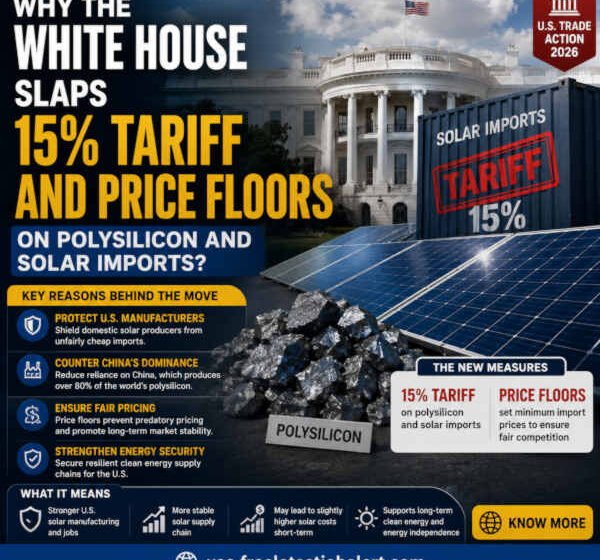
Why the White House Slaps 15% Tariff and Price Floors on Polysilicon and Solar Imports?Know more

WASHINGTON: Another USA breaking news on why the white house slaps 15% tax tariff today, and the price reduction for the Polysilicon materials and solar products imported items. This major tariff has been started to protect the US economy and supply chain system from the Chinese country. In a major trade intervention aimed at countering foreign dominance in high-tech energy supply chains, President Donald Trump signed a proclamation imposing a 15% tariff alongside strict minimum import price floors on polysilicon and its downstream components.
The action, invoking Section 232 of the Trade Expansion Act of 1962, targets raw polysilicon, silicon wafers, solar cells, and finished solar modules. Administration officials cited national security vulnerabilities caused by extreme U.S. reliance on overseas manufacturing, particularly from Chinese producers operating with heavy state subsidies.
The measures are scheduled to take effect on December 4.
Key Import Controls and Price Floors details
The White House order establishes a hybrid trade enforcement mechanism combining direct ad valorem tariffs with guaranteed price baselines:
| Material / Component | Minimum Import Price Baseline | Tariff Mechanism |
| Raw Polysilicon | $21.00 / kg | Subject to baseline enforcement |
| Ingots & Silicon Wafers | $100.00 / kg | 15% ad valorem tariff + price floor |
| Solar Cells | $0.22 / watt | 15% ad valorem tariff + price floor |
| Solar Modules (Panels) | $0.38 / watt | 15% ad valorem tariff + price floor |
Importers failing to certify that their initial domestic sale meets or exceeds these baseline prices will face an additional specific duty equal to the full applicable price floor.
Restructuring the Solar and Semiconductor Supply Chain
A year-long investigation by the U.S. Department of Commerce revealed a sharp contraction in domestic capacity. The U.S. share of global polysilicon production capacity collapsed from 50% in 2005 to under 2% in 2024, even as worldwide production expanded by more than 270% since 2020.
Polysilicon serves as the critical raw input for both semiconductor microchips and solar photovoltaic cells. Administration officials emphasised that protecting domestic refining is essential for sustaining domestic artificial intelligence infrastructure and defence systems.
Market Impact & Industry Reaction
-
Domestic Producers: Major producers like Hemlock Semiconductor (a joint venture of Corning and Shin-Etsu) and Munich-based Wacker Chemie welcomed federal support for long-term competitiveness in U.S. manufacturing.
-
Project Developers: Utility-scale solar developers and residential installers warned that price floors could drive up capital expenditure costs for renewable energy projects over the short term.
-
Capital Incentives: The proclamation authorises the Commerce Department to grant tariff exemptions to companies making firm capital commitments to build or expand domestic polysilicon refining facilities before early 2029.
Global manufacturers and domestic buyers now have a 120-day window to renegotiate supply contracts before the regulatory floor goes into effect on December 4.
Here, the reason for the white hoius allpign 15%tariif is also provided, along with the details of the key impacts and price of imported items.