
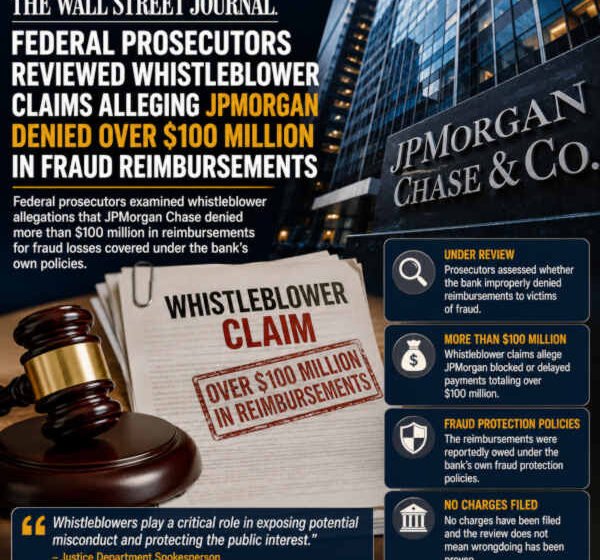
The Wall Street Journal Reports Federal Prosecutors Reviewed Whistleblower Claims Alleging JPMorgan Denied Over $100 Million in Fraud Reimbursements

NEW YORK : JPMorgan Chase & Co. is facing renewed scrutiny after The Wall Street Journal reported that U.S. federal prosecutors and Treasury Department officials reviewed whistleblower allegations claiming the bank mishandled fraud cases and improperly denied customers more than $100 million in reimbursements.
The scrutiny stems from a detailed whistleblower complaint filed last year by Christy Lillie, JPMorgan’s former head of scam prevention. Prosecutors from the U.S. Attorney’s Office for the Southern District of New York in Manhattan, alongside officials from the U.S. Department of the Treasury, met directly with Lillie and subsequently received supporting documentation detailing her claims.
While prosecutors have not formally alleged any wrongdoing, and it remains unconfirmed whether federal authorities maintain an active investigation, the report shines a spotlight on banking reimbursement practices and anti-money laundering compliance.
JPMorgan Chase has forcefully rejected the whistleblower’s assertions, maintaining that an internal investigation found no evidence of legal or regulatory breaches.
Anatomy of the Whistleblower Allegations
At the heart of the complaint is how Wall Street’s largest financial institution categorizes fraudulent account activity and handles consumer reimbursement claims under federal consumer protection standards.
The “Scam” vs. “Fraud” Distinction
According to the whistleblower complaint, JPMorgan classified certain customer losses as “scams” rather than “fraud”. Under existing federal banking regulations, including Regulation E under the Electronic Fund Transfer Act (EFTA), financial institutions are generally obligated to reimburse customers for unauthorised electronic transfers (fraud). However, when a consumer is tricked or manipulated into authorising a payment themselves—commonly referred to in industry parlance as an authorised push payment (APP) scam—banks historically faced less explicit statutory obligation to refund the victim.
The complaint alleges that by systematically categorising ambiguous or contested cases as consumer-authorised scams rather than unauthorised fraud, JPMorgan was able to deny reimbursement claims.
The $100 Million Reimbursement Impact
Lillie’s complaint alleges that internal estimates generated within JPMorgan revealed that changing its reimbursement policies could cost the bank at least $100 million in customer refunds. The complaint asserts that financial exposure was a primary driver behind maintaining strict denial criteria, leaving victimised accountholders to absorb severe financial losses.
Anti-Money Laundering (AML) Oversight Deficits
Beyond consumer reimbursement practices, the whistleblower complaint extends into institutional compliance. Lillie separately accused JPMorgan of failing to identify thousands of suspicious accounts that should have been flagged under anti-money laundering (AML) rules and Bank Secrecy Act (BSA) protocols. Such accounts are frequently utilised by organized cybercrime syndicates and money mules to launder illicitly obtained funds across banking networks.
JPMorgan’s Defiant Rebuttal
JPMorgan Chase moved swiftly to dismiss the whistleblower’s claims as baseless, issuing a statement defending its operational controls and legal compliance.
“We believe these claims have no merit. We took the concerns seriously, carefully reviewed them, and found no evidence of wrongdoing or violations of law,” a JPMorgan spokesperson told The Wall Street Journal.
The bank affirmed that its customer reimbursement procedures fully satisfy, and in many respects exceed, all statutory and regulatory requirements set by federal authorities. Regarding the AML allegations, the institution stated that internal audits found no evidence supporting assertions of systemic failure in account monitoring or suspicious activity reporting.
Operational and Regulatory Context
| Feature / Metric | Whistleblower Complaint Allegations | JPMorgan Official Stance |
| Primary Allegation | Classified fraud as “scams” to deny customer refunds | Denials comply fully with Regulation E and legal standards |
| Financial Exposure | Denied over $100M in customer reimbursements | Claims lack merit; internal reviews found no policy violations |
| AML Compliance | Failed to flag thousands of suspicious accounts | AML monitoring meets or exceeds federal requirements |
| Federal Review | SDNY Prosecutors & Treasury met with the whistleblower | No formal charges or enforcement actions filed |
The Broader Debate Over Consumer Fraud Protections
The revelations come amid an intense national debate surrounding consumer protections in modern electronic banking. The rapid adoption of real-time peer-to-peer (P2P) payment networks—such as Zelle, Wire, and ACH transfers—has triggered a parallel surge in sophisticated social engineering schemes targeting retail bank customers.
Regulation E and the Push for Reform
Consumer rights advocates and lawmakers, including members of the Senate Banking Committee, have long criticised major U.S. financial institutions for exploiting legal grey areas to deny scam victims recourse. While banks argue that paying out claims for consumer-authorised transfers creates moral hazard and invites fraudulent reimbursement claims, consumer advocates argue that mega-banks possess the technological capability and resources to intercept fraudulent transactions before execution.
The Consumer Financial Protection Bureau (CFPB) has repeatedly issued guidance signalling that financial institutions must scrutinise transaction contexts more aggressively, rather than automatically defaulting to claim rejections.
Industry Scrutiny on Peer-to-Peer Networks
The handling of wire and P2P scam claims has drawn formal inquiries from congressional committees and consumer protection regulators alike. If federal law enforcement or regulatory bodies choose to formalise investigations based on documents provided by internal whistleblowers, it could catalyse broader enforcement actions across the entire U.S. banking sector.
Market Reaction and Governance Implications
Following the publication of The Wall Street Journal report, shares of JPMorgan Chase & Co. (NYSE: JPM) traded relatively flat, rising 0.48% in subsequent sessions as investors digested the news. Market analysts noted that while the headline introduces short-term headline risk, the absence of formal criminal or civil charges from the U.S. Attorney’s Office has kept immediate market panic at bay.
However, corporate governance experts note that whistleblower complaints originating from high-level executives—such as a former head of scam prevention—carry significant weight inside federal regulatory circles.
Potential Legal & Operational Trajectories for JPMorgan:
1. Preliminary Document Review (Completed by SDNY / Treasury)
2. Decision on Formal Investigation (Pending / Unconfirmed)
3. Regulatory Audit by CFPB or OCC on Reimbursement Rates
4. Potential Policy Adjustments or Settlement Protocols
Should federal authorities launch a formal probe, investigators would likely focus on internal communications, risk committee records, and internal financial modelling related to the alleged $100 million reimbursement threshold.
Looking Ahead
The meeting between federal prosecutors, Treasury officials, and Christy Lillie underscores the expanding liability landscape confronting major financial institutions in an era of digital fraud. Whether this review culminates in administrative regulatory actions, formal enforcement proceedings, or is ultimately closed without action, it reinforces the immense pressure on Wall Street banks to balance loss prevention against customer protection.
As digital transaction volumes accelerate, the boundary between an “authorised scam” and “unauthorised fraud” remains one of the most contentious legal battlegrounds in modern American banking, with JPMorgan Chase positioned directly at its centre.