
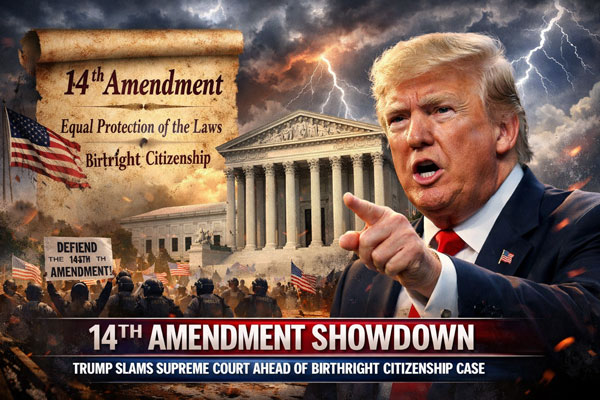

USA BREAKING NEWS: As the Supreme Court prepares for oral arguments in the landmark case Trump v. Barbara on April 1, 2026, the United States stands at a constitutional crossroads. At the heart of the storm is the 14th Amendment’s Citizenship Clause—a post-Civil War pillar that has guaranteed citizenship to nearly everyone born on U.S. soil for over 150 years.
President Donald Trump, following through on a cornerstone promise of his second term, has moved to dismantle this “magnet” for illegal immigration. The resulting legal battle is not just a policy debate; it is a fundamental challenge to the American identity.
The Executive Order: Redefining “Jurisdiction”
On January 20, 2025, his first day back in office, President Trump signed Executive Order 14160, titled “Protecting the Meaning and Value of American Citizenship.” The order directs federal agencies to withhold citizenship documentation (Social Security cards and passports) from children born in the U.S. if their mother is:
- Unlawfully present (undocumented).
- Lawfully but temporarily present (such as on a tourist or short-term work visa).
The administration’s legal theory hinges on the phrase “and subject to the jurisdiction thereof” in Section 1 of the 14th Amendment. Solicitor General D. John Sauer argues that “jurisdiction” implies a “complete political allegiance” that temporary visitors and undocumented immigrants cannot possess.
The Judicial Journey: From New Hampshire to DC
Almost immediately, the order was met with a barrage of lawsuits. While the administration initially faced “universal injunctions” from courts in Washington and Maryland, a June 2025 Supreme Court ruling (Trump v. CASA) limited the power of district judges to issue nationwide blocks.
However, the current case, Trump v. Barbara, originated in New Hampshire. U.S. District Judge Joseph N. LaPlante issued a preliminary injunction protecting a certified class of infants born after February 20, 2025. LaPlante ruled that the executive order “likely contradicts the text of the Fourteenth Amendment and a century-old untouched precedent.”
The Legal Heavyweights: 1898 vs. 1884
The Supreme Court battle will largely be a duel between two Gilded Age precedents:
- United States v. Wong Kim Ark (1898): This is the gold standard for birthright citizenship. The Court ruled that a child born in San Francisco to Chinese parents (who were then legally barred from becoming citizens themselves) was an American citizen at birth.
- Elk v. Wilkins (1884): The Trump administration relies on this case, which denied citizenship to a Native American man because he owed allegiance to his tribe. The administration argues that children of undocumented immigrants similarly owe “primary allegiance” to a foreign sovereign.
A “Stupid” System? Trump Slams the Court
In typical fashion, the President has not stayed silent as the case reaches the high court. On March 30, 2026, Trump took to Truth Social to lambast the federal judiciary, calling the legal roadblocks “stupid” and “dumb.”
“Dumb Judges and Justices will not a great Country make!” the President wrote, adding that the U.S. is “the only country in the world where someone can walk over a border and suddenly their baby is a citizen for 80 years with full benefits.”
Critics, including the ACLU and the Constitutional Accountability Center, argue that Trump is attempting to unilaterally rewrite the Constitution—a power reserved for Congress and the states through the amendment process.
Frequently Asked Questions (FAQs)
Q: Is birthright citizenship currently suspended?
No. Due to the preliminary injunction in Trump v. Barbara, the executive order is currently on hold. Children born in the U.S. are still being issued birth certificates and Social Security numbers regardless of their parents’ status.
Q: Does the 14th Amendment actually mention immigrants?
The text says: “All persons born or naturalized in the United States, and subject to the jurisdiction thereof, are citizens…” It does not explicitly mention “immigrants,” but the 1898 Wong Kim Ark decision clarified that “all persons” includes the children of non-citizens.
Q: What happens if Trump wins the case?
If the Supreme Court upholds the order, a U.S. birth certificate would no longer be sufficient to prove citizenship. Parents would likely need to provide proof of their own legal status (e.g., a Green Card or U.S. Passport) to secure their child’s citizenship.
Q: When will the Supreme Court decide?
Oral arguments are set for April 1, 2026. A final decision is expected by the end of June or early July 2026.