
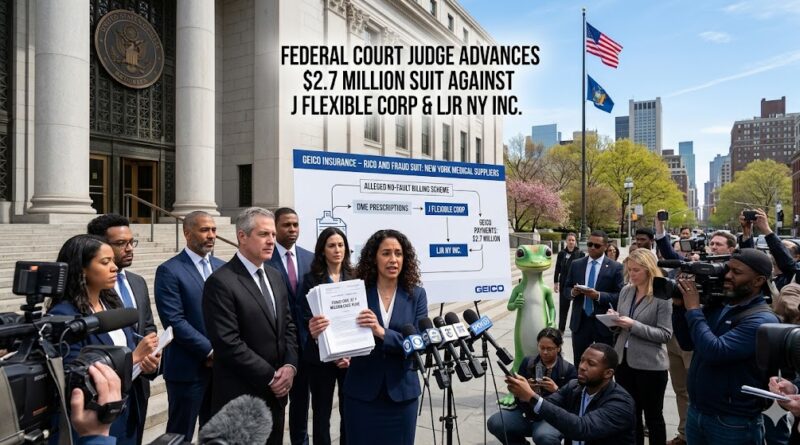
GEICO Insurance: Federal Judge Advances $2.7 Million RICO and Fraud Suit Against New York Medical Suppliers
BROOKLYN, NY — In a major development for the insurance industry’s ongoing war against no-fault billing abuse, a New York federal judge has cleared the way for a multi-million dollar racketeering and fraud lawsuit brought by GEICO to proceed. The ruling, issued in the Eastern District of New York, keeps the core of GEICO’s $2.7 million case alive against a network of Brooklyn-based medical equipment suppliers and their owners.
The decision comes at a pivotal moment for GEICO Insurance as it balances a massive March Madness marketing blitz with aggressive litigation aimed at dismantling what it describes as a sophisticated “kickback and billing” enterprise.
The Alleged Scheme: Over $2.7 Million in “Unnecessary” Equipment
At the heart of the lawsuit are J Flexible Corp., LJR NY Inc., and their owner, Yevgeniya Ivanova. According to court documents, GEICO alleges that these entities participated in a complex scheme to exploit New York’s no-fault insurance laws, which require insurers to pay for medical treatments and equipment regardless of who caused an auto accident.
Key Allegations in the Suit:
- Fraudulent Billing: The defendants allegedly submitted over $2.7 million in claims for durable medical equipment (DME), including high-priced bone stimulators and specialized mattresses.
- Lack of Necessity: GEICO contends much of this equipment was never delivered to patients or was “medically unnecessary,” often prescribed for minor injuries that did not warrant such expensive interventions.
- The Kickback Ring: The insurer claims the suppliers paid illegal kickbacks to clinic operators and “runners” who funneled prescriptions to them, some of which were allegedly signed by unlicensed staff or forged entirely.
The Ruling: RICO Claims Survive Dismissal
The defendants moved to dismiss the case, arguing that GEICO’s allegations lacked the specificity required for federal racketeering and fraud charges. However, the presiding judge found that GEICO had met the “sufficient case” threshold to move forward with:
- RICO Conspiracy: Claims under the Racketeer Influenced and Corrupt Organizations Act, which allows for triple damages if a criminal enterprise is proven.
- Common-Law Fraud: Allegations that the defendants intentionally deceived the insurer to extract payments.
- Unjust Enrichment: Seeking the return of funds already paid out under the allegedly fraudulent billing.
While the judge did “axe” some overlapping claims to streamline the trial, the survival of the RICO counts is a significant blow to the defendants, as it allows GEICO to conduct broad discovery into the entire operation’s financial and organizational structure.
The “New Blueprint”: Federal Courts vs. State Arbitrations
This ruling is part of a broader “New Blueprint” being utilized by major carriers like GEICO and State Farm. Traditionally, no-fault disputes were settled through thousands of individual state-level arbitrations. Now, insurers are bundling these claims into massive federal RICO suits.
“Reviewing aggregated claims allows the court to identify patterns and discern whether defendants adhered to pre-determined treatment protocols regardless of individual medical needs,” noted judges in a similar recent GEICO victory.
By staying hundreds of smaller collection suits while the federal RICO case is pending, GEICO avoids the risk of “inconsistent judgments” and prevents its fraud allegations from being buried under a mountain of paperwork.
A Week of Mixed Results for GEICO
While the J Flexible ruling is a win, GEICO’s legal week hasn’t been without its hurdles. On March 10, 2026, the Second Circuit vacated a different GEICO victory in a separate kickback fight. That court clarified that under New York law, insurers cannot deny no-fault payments solely based on “professional misconduct” (like paying for referrals) unless that misconduct actually results in an unlicensed party taking control of the medical practice.
This “granular” distinction highlights why cases like the J Flexible suit are so critical—they focus not just on misconduct, but on the actual legitimacy of the medical services provided.
Frequently Asked Questions (FAQs)
1. What is a RICO claim in an insurance context?
RICO (Racketeer Influenced and Corrupt Organizations Act) allows insurers to sue organized groups they believe are working together to commit systematic fraud. If successful, the insurer can recover three times the amount of money they lost.
2. Why does the New York “no-fault” system lead to so much fraud?
Because the system requires insurers to pay claims quickly (usually within 30 days) regardless of who was at fault, fraudulent providers often flood the system with small, difficult-to-verify claims for medical equipment and therapy.
3. How does this affect GEICO customers?
According to the New York DFS, insurance fraud adds an average of $300 per year to every law-abiding driver’s premium. GEICO’s litigation is aimed at recovering these costs to stabilize rates.
Reference Links
- Law360: GEICO vs J Flexible Corp Docket
- Justia: Eastern District of New York Case Filings
- GEICO Newsroom: Corporate Legal Updates
Would you like me to create an infographic illustrating how the “no-fault” billing fraud scheme allegedly works?
